

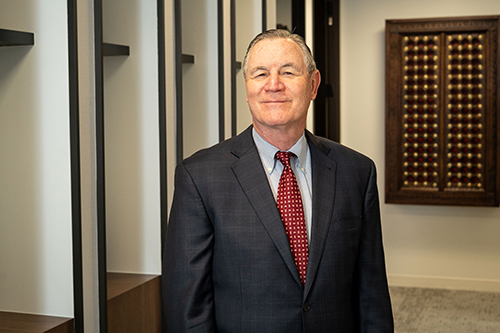
Although neutral Ted D. Levin spent nearly four decades litigating construction disputes, he began his professional career as a structural engineer.
"I always had an interest in construction," Levin said, recalling his childhood in Denver. "And it wasn't just how buildings and other structures were built but also how they were designed."
Levin earned an architectural engineering degree from the University of Colorado Boulder in 1980 and worked for nearly four years as a licensed engineer on a variety of construction projects before enrolling at the University of San Francisco School of Law.
"I've got a number of family members who were lawyers," Levin said. "So being exposed to lawyers and lawyering when I was young, ... it was sort of a natural transition for me to go to law school after practicing as an engineer and to apply my engineering and construction capabilities to the law."
Levin joined ADR Services, Inc.'s roster of private neutrals in early 2025. While the longtime litigator said his strength remains mediating and arbitrating construction disputes, he noted that his practice now spans a wide range of cases.
"I do real property disputes. I've done landlord-tenant. I've done personal injury. I've even done intellectual property disputes," Levin said. "And I've found that even an ordinary automobile personal injury dispute can involve engineering-related issues - speed of the vehicles and biomechanical issues, for example - where my engineering background can be helpful because of my understanding and training."
Levin said that background is especially useful in real property disputes, which often include construction defect claims or engineering and architectural design issues.
As an arbitrator, Levin said he focuses on fairness, giving parties a full opportunity to present their positions and making sure they feel comfortable with the process. His technical background, he said, can be a particular advantage in construction cases, where disputes are often highly complex.
"I'm able to evaluate technical issues others may not be able to understand," Levin said. "So, I'm able to save a lot of time and money, I believe, because of my training and experience."
As a mediator, Levin said he takes a similarly attentive approach, listening carefully to all sides while bringing a more evaluative style to the process.
"I'm not afraid to tell a party or attorneys ... privately what I think are the benefits of their case - the good, the bad and the ugly," Levin said. "I feel, at least to some degree, the reason they're hiring me is to get that neutral, independent, knowledgeable evaluation."
Newport Beach construction litigator Kimberly J. Manning has used Levin as a mediator in several disputes and said he is persistent and easy to work with.
"You can't help but like him," Manning said. "And he works really, really hard. He won't let up. ... Even if you don't settle it when you're paying, he follows up without pay to get it settled. He's just like a dog with a bone. He wants these cases resolved, and he makes it happen."
Santa Ana litigator Bill H. Kollias recently used Levin to resolve a particularly contentious construction dispute and said the neutral's even-keeled demeanor was a major asset.
"He remained calm throughout, but he was persistent," Kollias said. "When the parties are animated, and you have someone that can stay in control and calm the parties and be that voice of reason, that's really what gets it done."
Levin said overly combative attorneys can make mediation more difficult.
"I, of course, appreciate a lawyer who states their position and believes in their and their party's position," he said. "But being obstreperous or interfering with the process is not productive and just slows things down and costs time and money."
Levin said he prefers to move efficiently in mediations, relying on pre-mediation calls to help him identify the central issues before the session begins.
"I really try to work hard to weed out the peripheral or non-productive issues," Levin said. "Some of these may be emotional, and emotional issues are important, but they may not be as productive in terms of getting the case settled."
Pasadena construction litigator Aaron J. Flores recently used Levin to resolve a multifamily construction project dispute and praised his direct approach.
"There are some mediators that use pressure tactics or use the emotional approach," Flores said. "Ted was just straight down the middle. ... Just very professional, very straightforward, but in a way where he's dialing into the issues immediately, so that we could ultimately get the case settled."
Like Manning and Kollias, Flores said Levin's combination of construction litigation experience and engineering training distinguishes him from many other mediators. He pointed to the numerous and often complex contractual documents involved in construction projects.
"Ted just has a good mastery of the universe of those documents and those obligations," Flores said. "Sometimes people can get really narrowly focused on a certain point of the contract, and Ted's able to provide that broader perspective and experience to say, 'Hey, you got to take a step back and look at the entire universe of the document and the obligations.' That's really important because what you want in mediation is someone who can be that mouthpiece, offering broader perspectives."
Levin said he is especially enjoying this stage of his career because it allows him to apply his experience and training to a wide range of disputes.
"Every case is different, and they all usually involve very new and esoteric and interesting issues," he said. "Each case can develop kind of like a mini science experiment. And I enjoy getting my hands dirty and really digging in on the issues and the claim and figuring out what happened."
Here are some attorneys who have used Levin's services: Bill H. Kollias, Prenovost, Normandin, Dawe & Rocha; Aaron J. Flores, Flores Ryan LLP; Kimberly J. Manning, Manning Construction Law, Inc.; Dean Weinreich, Law Office of Dean Weinreich; Colette R. Magnetta, Armijo, Morovati & Shields