


Jun. 26, 2026
Southwestern Law School puts Bullocks Wilshire's history back on display
A century after Bullocks Wilshire rose on a bet that shoppers would never travel west of downtown, Southwestern Law School is filling the Art Deco landmark's storefront windows with vintage fashion from its own archives -- a stewardship story three decades in the making.


By Douglas Saunders
She'd been turning heads on Wilshire Boulevard since 1929 -- Bullocks Wilshire, Art Deco from crown to heels, the kind of dame a city builds around. Owners changed; the glamour didn't. And it still hasn't.
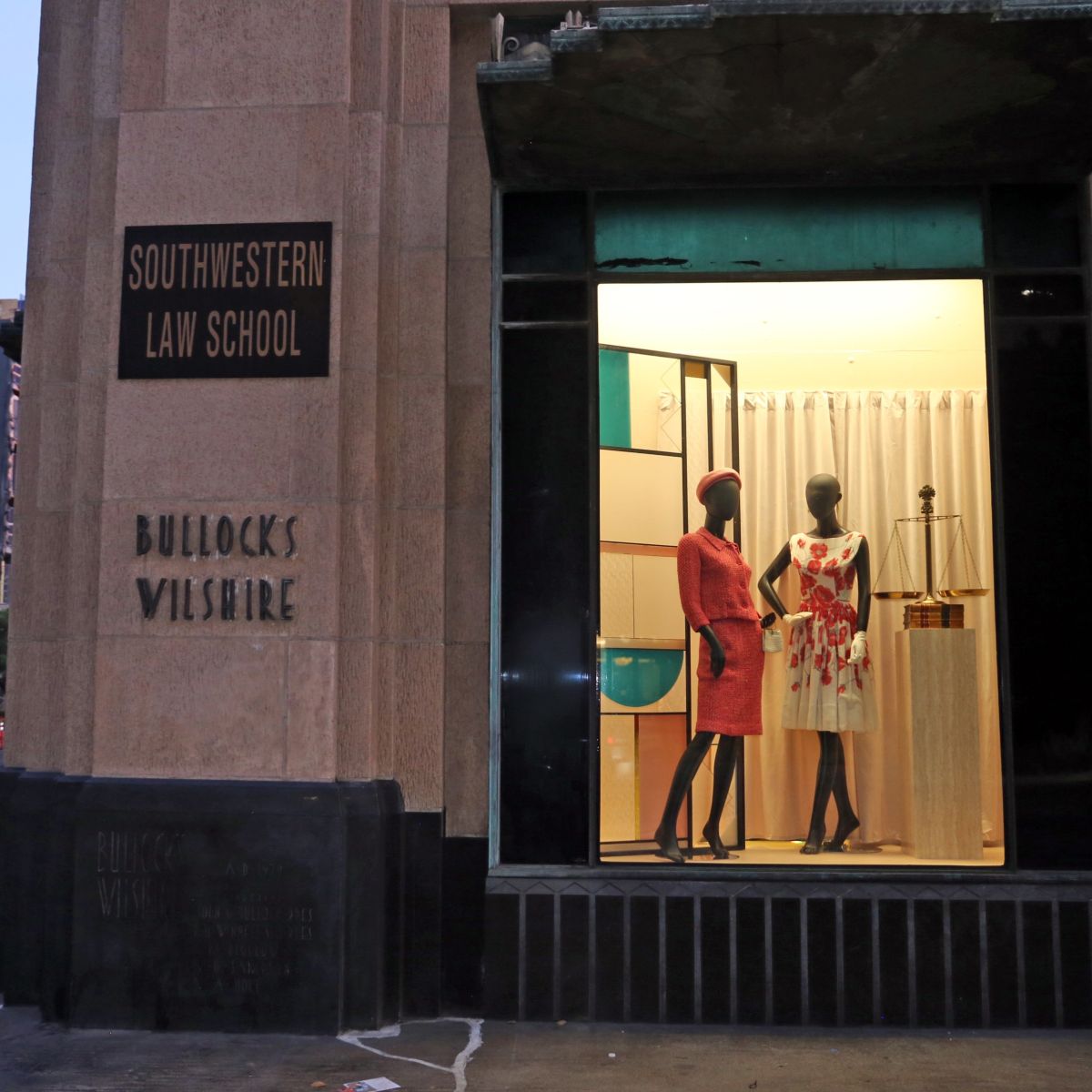
Today the 1929 Art Deco landmark houses Southwestern Law School, which took her in back in 1994 and now showcases her retail past, filling three Wilshire Boulevard windows with vintage women's fashion from the school's vault -- the past, behind glass, returning to the present.
The displays were created by Southwestern Law Dean Darby Dickerson and Walter Yoka, a 1980 Southwestern graduate, founder of the Los Angeles trial firm Yoka Smith, and vice chair of the school's board of trustees. He views the project as overdue recognition of the law school's three decades of care for one of the city's most iconic structures.
For Dickerson, the building is more than a campus. "We have people calling us to come through this building from around the world, because it really is one of the jewels of Art Deco," she said, describing it as a jewel for Los Angeles.
Southwestern, she added, considers itself "Los Angeles's law school," and becoming the building's steward "is a real honor." That role, she noted, predates the school's ownership: Southwestern had stood next door for decades, and during the 1992 riots, she said, it helped save the building.
For Yoka, the story begins with the building's architect, John Parkinson, whom he calls "LA's architect" -- an English-born designer who arrived in the United States with no formal architectural training. Parkinson's credits, Yoka noted, include City Hall, the Coliseum, Union Station and Bullocks Wilshire.
"If that's not LA's architect, it's hard for me to imagine who would be," Yoka said. "This is the guy who designed the most iconic and recognizable structures in Los Angeles."
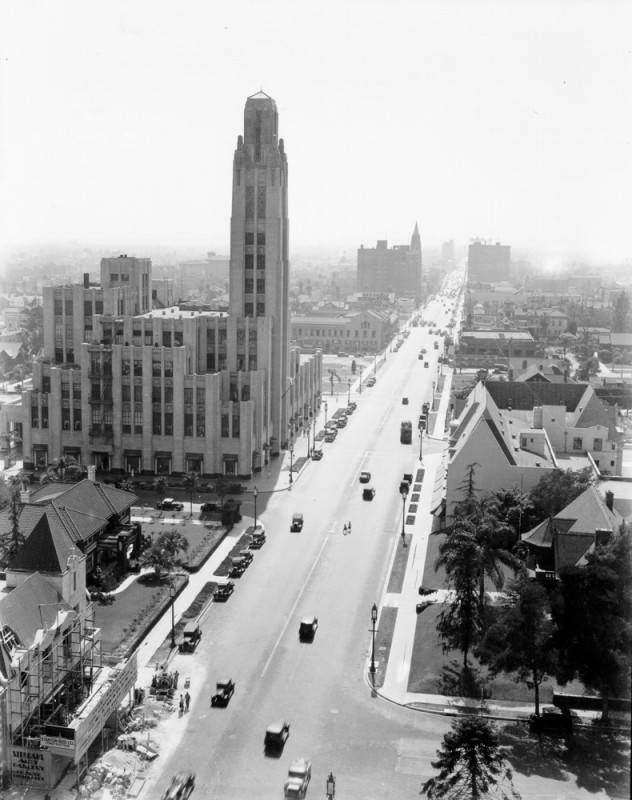
Building Bullocks Wilshire was a gamble. John Bullock, who had run the Broadway department store downtown, hired Parkinson to put a soaring retail tower west of the city's core at a time when, as Yoka tells it, the idea seemed far-fetched.
"Nobody thought that people would travel west from downtown LA to shop," Yoka said.
The tower, completed in 1929, instead drew the city toward it, helping push development out along the Wilshire corridor. Yoka described it as a beacon of retail fashion that became, in his telling, one of the country's finest examples of Art Deco commercial design.
As retailing changed and the vast building grew harder to maintain, Southwestern purchased it in 1994. The school preserved not only the architecture but a vault of women's fashions spanning the early 1900s to the mid-1900s, a collection Yoka said it kept intact rather than discard.
The window project grew from that inheritance. Dickerson traces it to her first weeks in Los Angeles in 2021. Store-branded items were on display in the building's old perfume hall, she said, but some were on loan -- and about three weeks into her tenure, an owner asked for them back.
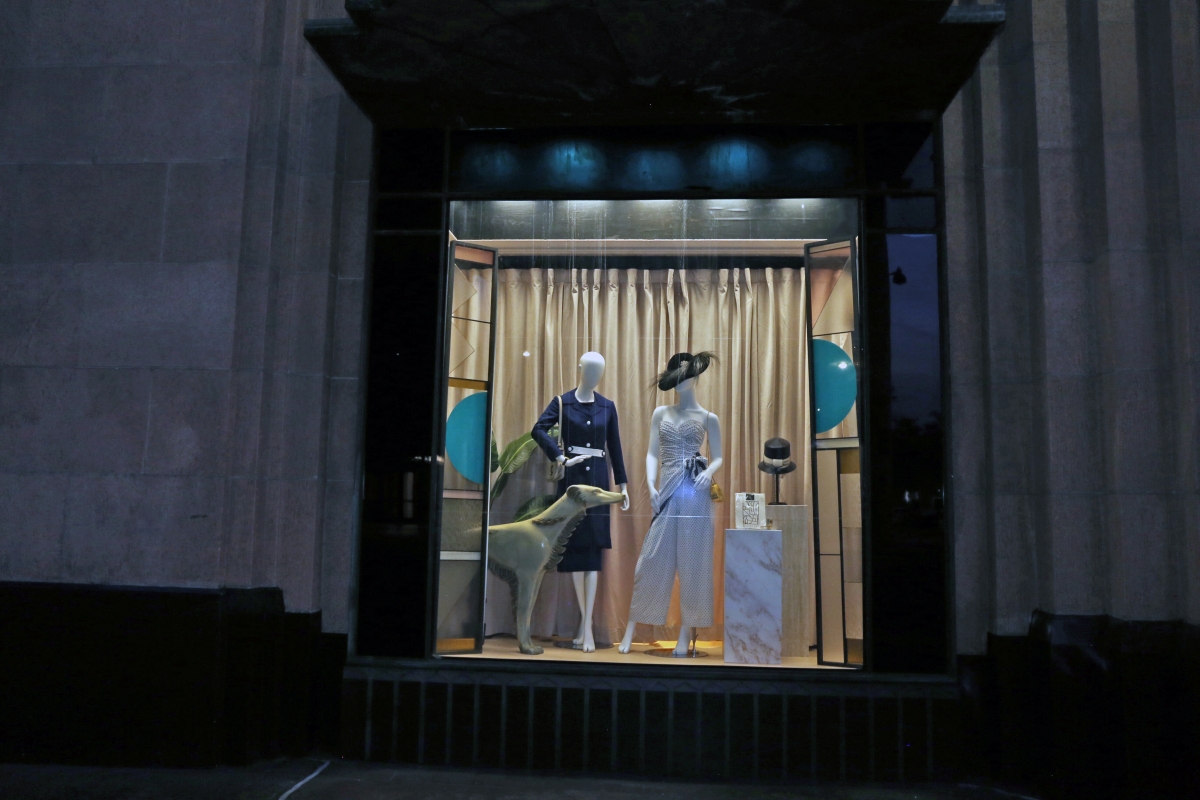
As stewards of the building, she decided, the school "should never be without significant pieces of that history." She and the law librarian began acquiring Bullocks Wilshire-branded fashion, the earliest pieces dating to the 1930s and running into the 1980s, and the school brought on an archivist to manage the growing collection.
The idea of moving it all into the storefront windows, by Dickerson's account, came from Yoka himself. When he raised it with her -- asking why the school could not use the windows that once advertised the store's wares along Wilshire -- the archives gave up their first three displays.
The school worked with Matt and Katie Allison to design them, and "Darby and her team got to work," Yoka said. The result, Dickerson said, "brightened up the block."
Students absorb the building's history daily, Yoka said. The lobby's elevator banks and glass casements display artifacts from the store's heyday, the fourth-floor tea room now serves as the student cafeteria, and in the former men's department, now part of the library, a brickwork homage to Frank Lloyd Wright remains.
When the building was restored roughly three decades ago, Dickerson said, it was taken back to its 1929 appearance -- a contrast that surprises older visitors who remember the store's later renovations.
Among the rediscoveries was a tiled, Spanish-style drinking fountain that had been walled over; during the restoration, she said, someone consulted old blueprints, took a sledgehammer to the wall and "thank goodness he was right."
She works from what the school calls its ceremonial office -- once the office and apartment of the store's owner -- which opens onto a balcony with views of the downtown skyline, USC to the south and the hills rising toward the Griffith Observatory.
It is, she said, "the envy of deans across the country." The school has also opened the building to the public through its Bullocks Wilshire Salon series, and is now preparing for two milestones: Southwestern's 115th anniversary, which began in November, and the building's centennial in 2029.
The building's pull on Los Angeles culture outlasted its retail era. Actress Angela Lansbury once worked there, Yoka said, and the building has since appeared in films such as "Bugsy" and in an Aerosmith music video for "Love in an Elevator." For readers wanting more on Parkinson, he recommended the book "Iconic Vision."
The larger point, Yoka suggested, is that Los Angeles rarely surrenders its history easily.
"LA is not like San Francisco and New York. You have to really work at it," he said.
For Yoka, the effort is personal. He framed the windows, and the attention he hopes they draw, as a way of repaying a debt to the school he credits for his career and calls the oldest law school in Los Angeles.
"Southwestern gave me an opportunity to have the legal career that I now have," he said. "This is part of giving back to your own history and origin."
The recognition, he said, belongs to the school. "It kind of gives Southwestern what I think to be some well-deserved recognition for being the steward of this piece of LA history," Yoka said.
Dickerson sees the windows as part of a longer arc -- a building that, in her words, ties the school and its students to Los Angeles in a way she hopes they will "carry into the future
For reprint rights or to order a copy of your photo:
Email
Jeremy_Ellis@dailyjournal.com
for prices.
Direct dial: 213-229-5424
Send a letter to the editor:
Email: letters@dailyjournal.com